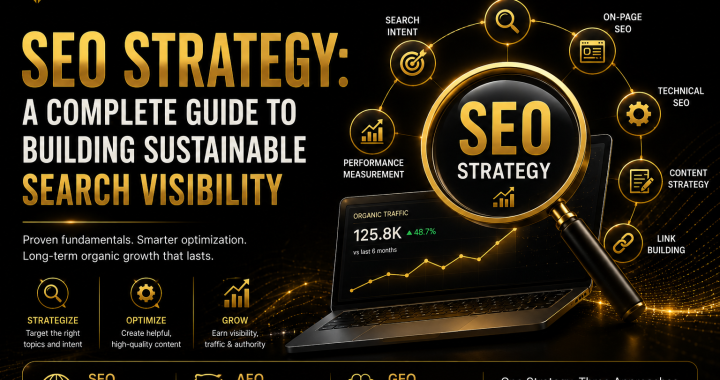
SEO Strategy & Fundamentals: A Guide to Sustainable Search Visibility
A successful SEO strategy is more than just adding keywords to a webpage.
Today, businesses must optimize content for traditional search engines, question-based search experiences, and AI-driven discovery.This means integrating Search Engine Optimization (SEO), Answer Engine Optimization (AEO), and Generative Engine Optimization (GEO) to create content that is helpful, easy to find, and easy to understand.
This guide covers the key SEO fundamentals needed to build lasting search visibility and long-term website growth.
What Is SEO?
Search Engine Optimization (SEO) refers to the process of improving a website’s visibility in search engine results.
It involves optimizing content, site structure, technical performance, keywords, and user experience.The goal of an effective SEO plan is not just to rank for more keywords, but to attract the right audience by creating content that meets their needs and matches their search intent.
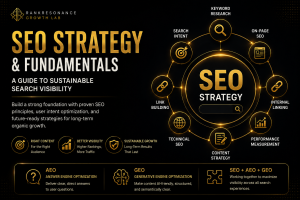
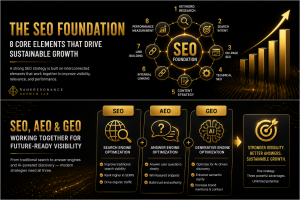
The main components of SEO include:
• Keyword research
• Search intent
• On-page SEO
• Technical SEO
• Content strategy
• Internal linking
• Link building
• Performance measurement
These elements work together to build a strong SEO foundation and support long-term organic growth.
1. Keyword Research and Search Intent
Keyword research helps you understand what your audience is searching for and how they look for information online.
However, modern SEO should not be limited to individual keywords.Search engines are now better at understanding topics, relationships, and user intent.
For example, an article about keyword research can naturally cover related topics like long-tail keywords, keyword difficulty, search volume, competitor analysis, and search intent.
Understanding search intent is just as important.Before creating content, ask: What does the user want to achieve?
Common types of search intent include:
• Informational
• Navigational
• Commercial
• Transactional
Matching your content with the right search intent improves its value and raises the chances of performing well in search results.
2. On-Page SEO
On-page SEO involves optimizing individual pages so both users and search engines can easily understand the content.
Key elements include:
• SEO titles
• Meta descriptions
• Headings
• URL structure
• Internal links
• Image optimization
• Relevant keywords
Your main keyword should appear naturally in key areas, while related keywords help provide context.
Avoid keyword stuffing.A solid on-page SEO approach focuses on relevance, readability, search intent, and covering the topic thoroughly rather than repeating the same keyword unnecessarily.
3. Technical SEO and Website Structure
Technical SEO ensures that search engines can easily crawl, understand, and index your website.
Important technical areas include:
• Crawlability and indexability
• XML sitemaps
• Page speed
• Mobile usability
• Canonical URLs
• HTTPS
• Structured data
• Website architecture
A clear and logical website structure helps both users and search engines find related content.
Important pages should not be hidden too deep in the website.A well-organized hierarchy increases crawlability and strengthens your overall SEO strategy.
4. Content and Topical Authority
High-quality content is a key part of successful SEO.
But simply publishing many unrelated articles doesn’t automatically build authority.A better approach is to create topic clusters.
A topic cluster usually includes:
1.A main pillar page covering a broad topic.
2.Supporting articles on specific subtopics.
3. Internal links connecting related content.
For example, “SEO Strategy & Fundamentals” can act as a pillar page linking to topics like keyword research, on-page SEO, technical SEO, off-page SEO, and SEO planning.
This structure strengthens topical relationships and supports long-term SEO growth.
5. Internal Linking
A good internal linking strategy connects related articles and helps search engines understand your site’s structure.
For instance:
SEO Strategy & Fundamentals
→ Keyword Research
→ On-Page SEO
→ Technical SEO
→ Off-Page SEO
→ SEO Planning
Each supporting article should link back to the related pillar page and, where useful, to other related content.
Effective internal links help users discover more content, create clearer topic connections, and encourage further exploration of your website.
SEO and Answer Engine Optimization (AEO)
Answer Engine Optimization (AEO) focuses on structuring content to provide clear and direct answers to user questions.
People are increasingly searching using full questions such as:
• What is SEO?
• How does keyword research work?
How can I improve organic traffic?
To improve AEO, directly answer important questions before adding more details.
For example: What is an SEO strategy?
An SEO strategy is a structured plan for improving search visibility through content optimization, technical improvements, keyword targeting, internal linking, and authority building.
Useful AEO practices include clear headings, concise definitions, question-based sections, lists, and logically structured content.
SEO and Generative Engine Optimization (GEO)
Generative Engine Optimization (GEO) focuses on making content clear, useful, and understandable within AI-powered and generative search experiences.
The principles behind GEO overlap with strong SEO practices.
Content should provide:
• Clear explanations
• Accurate information
• Logical structure
• Strong topical coverage
• Recognizable concepts and entities
• Original insights and useful context
For GEO, it is important to clearly explain the relationships between topics.
For example, a website should show how SEO, AEO, GEO, keyword research, content strategy, and search visibility connect.
Semantic clarity helps both users and machine-based systems better understand your content.
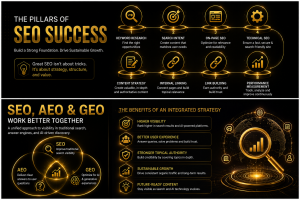
How SEO, AEO, and GEO Work Together
These approaches should not be treated as separate strategies.
Approach Primary Focus
SEO Improving traditional search visibility
AEO Providing direct answers to user questions
GEO Improving visibility and understanding in AI-driven search
A strong SEO strategy provides the foundation.
AEO improves how clearly your content answers questions, while GEO helps prepare your website for evolving AI-powered search experiences.
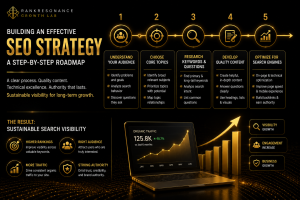
How to Build an Effective SEO Strategy
Follow these five steps:
1. Understand Your Audience Identify your audience’s problems, goals, questions, and search behavior. A successful SEO strategy begins with understanding user needs.
2. Choose Core Topics Identify broad subjects relevant to your website, such as SEO, content marketing, keyword research, technical SEO, and digital growth.
3. Research Keywords and Questions Use keyword research to identify primary topics, long-tail keywords, and common questions your audience might search for.
4. Develop Quality Content Create content that provides value, answers user questions, and is well-structured.
Use headings, lists, and clear explanations to enhance readability and comprehension.
5. Optimize for Search Engines Ensure your content is optimized for search engines by using relevant keywords, improving website speed, and building backlinks.
By following these steps, you can build a solid SEO strategy that supports your overall online presence and helps improve organic traffic.
Learn More About SEO
If you’re starting your SEO journey or want a practical perspective on how to learn SEO from the ground up, watch this video: