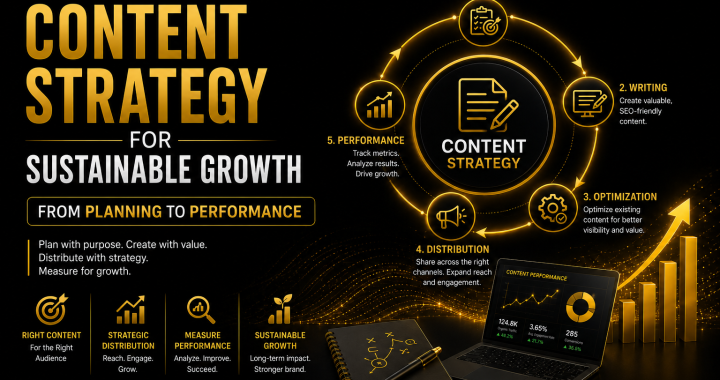
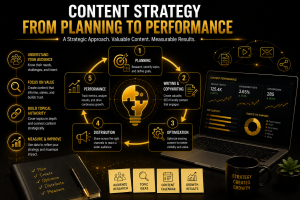
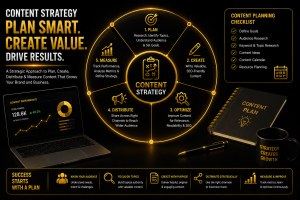
Content Strategy for Sustainable Growth: From Planning to Performance
A successful digital presence requires more than just publishing content regularly.
Businesses need a clear content strategy that connects audience needs, search visibility, brand goals, and measurable results. An effective content strategy framework helps organize the entire content lifecycle—from planning and writing to optimization, distribution, and performance measurement.
Whether you are building a new website or improving an existing one, a structured approach to content marketing can help create sustainable traffic, stronger audience engagement, and long-term digital growth.
1. Content Planning: Building a Strong Foundation
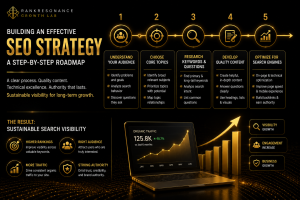
Every successful strategy begins with a clear content planning process.
Before creating an article, blog post, landing page, or guide, it is important to understand who the content is for and what problem it should solve.
A strong content planning process should consider:
1.Target audience and buyer needs
2.Search intent and user questions
3.Relevant keywords and topics
4.Business and marketing goals
5.Competitor content gaps
6.Publishing priorities
Instead of creating unrelated articles, organize content into topic clusters.
A broad pillar page can cover a major subject, while supporting articles explore specific subtopics.
For example, a main category on Content Strategy & Content Marketing could connect articles about content planning, SEO content writing, content optimization, content distribution, and performance analysis.
This approach creates a more organized website and supports stronger topical relevance.
2. Content Writing & Copywriting
Once the strategy is defined, the next step is creating content that is useful, clear, and relevant. Effective SEO content writing should balance search optimization with genuine value for the reader.
Keywords can help communicate topical relevance, but content should always focus on answering the user’s question or solving their problem.
Some practical website copywriting tips include:
1. Start with a clear and engaging introduction.
2.Use descriptive headings and short paragraphs.
3.Focus on benefits as well as features.
4.Use simple and direct language.
5.Include relevant calls to action.
6.Match the tone to your target audience.
Strong content should guide readers naturally from one idea to the next.
It should also provide enough depth to answer the search query without adding unnecessary information.
For SEO, use primary and related keywords naturally within the content. Avoid keyword stuffing and focus instead on search intent, topical coverage, and readability.
3. Content Optimization and Refreshing
Publishing content is not the final stage of the content lifecycle. Websites should regularly optimize existing content to maintain its accuracy, usefulness, and search visibility. A structured content refresh strategy can identify pages that have declining traffic, outdated information, weak engagement, or opportunities for improvement.
When refreshing content, consider:
1.Updating outdated statistics or information
2.Improving keyword and search intent alignment
3.Adding new insights and examples
4.Improving headings and readability
5.Strengthening internal links
6.Adding relevant questions and answers
7.Reviewing titles and meta descriptions
Not every page needs to be rewritten completely. Sometimes, small improvements can make content more useful and relevant. Regular content optimization also helps businesses maintain a high-quality website rather than continuously adding new pages while ignoring existing ones.
4. Content Distribution and Promotion
Creating high-quality content is only part of the strategy. A strong content distribution strategy helps ensure that valuable content reaches the right audience.
Relevant content promotion channels may include:
1.Organic search
2.Social media platforms
3.Email newsletters
4.Industry communities
5.Professional networks
6.Digital partnerships
7.Repurposed content formats
Different types of content may perform better on different channels.
A detailed blog article can be repurposed into social media posts, email content, short videos, infographics, or presentation material.
However, content distribution should not mean posting the same message everywhere. Adapt the format and messaging to suit the platform and audience. An effective distribution strategy extends the lifespan of your content and creates multiple opportunities for users to discover it.
5. Content Performance and Measurement
The final stage is understanding whether your content is achieving its intended goals. Tracking relevant content marketing metrics helps identify what is working and where improvements are needed.
Important metrics may include:
1.Organic traffic
2.Search visibility
3.Keyword rankings
4.Click-through rate
5.Engagement
6.Time on page
7.Conversions
8.Leads or assisted conversions
Understanding how to measure content performance involves more than looking at just one metric. For instance, high traffic alone does not always mean business success if visitors do not take meaningful action.
Instead, it is important to link content performance to its intended purpose. An informational article might focus on organic traffic and engagement, whereas a commercial landing page might place greater emphasis on conversions. Consistent analysis helps marketers identify which topics are performing well, update content that is not doing as well, and make better decisions for future content creation.
How Content Strategy Supports SEO, AEO, and GEO
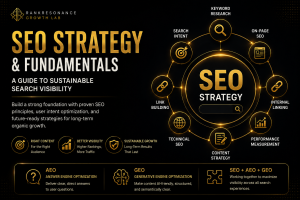
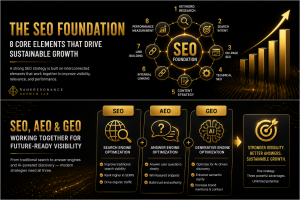
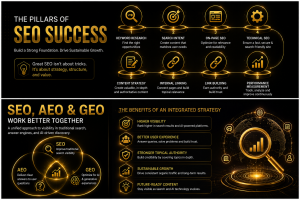
Today’s content marketing should also take into account the evolving search landscape. A strong content strategy framework can support traditional SEO, Answer Engine Optimization (AEO), and Generative Engine Optimization (GEO).
For SEO, content should focus on relevant topics, align with search intent, and include a logical internal linking structure.
For AEO, content should offer clear and direct answers to important questions through descriptive headings, concise explanations, and well-organized information.
For GEO, content should be accurate, contextually clear, and structured in a way that helps AI-powered search systems better understand the relationships between topics and concepts.