The Future of Search: AI, Emerging SEO & Digital Visibility

AI, Search Evolution & Emerging SEO: Preparing for the Future of Search


Search is changing quickly.

Traditional search engines are becoming smarter systems that can understand context, answer complicated questions, summarize information, and create responses using artificial intelligence.

For businesses, marketers, and website owners, this means that using only traditional SEO may not be enough.

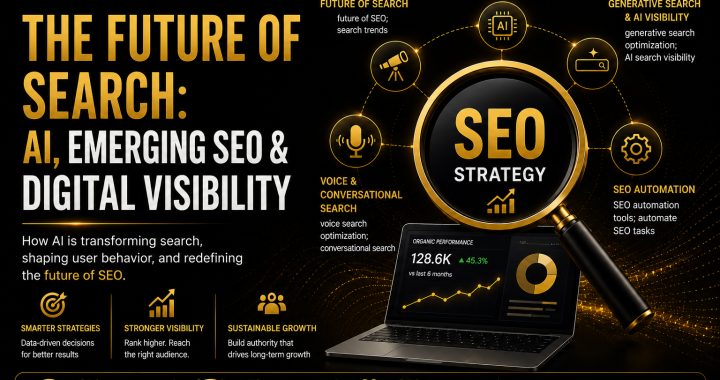
A modern approach to search should also include AI for SEO, generative search optimization, AI search visibility, SEO automation, voice search optimization, and emerging search trends.

This guide looks at how artificial intelligence is affecting search and how websites can get ready for the future of SEO.


AI for SEO: How Artificial Intelligence Is Changing Optimization
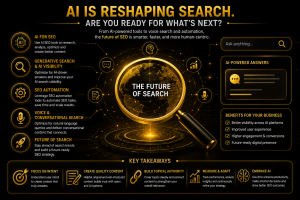
Artificial intelligence is becoming a key part of modern SEO.

AI SEO tools can help marketers look at large amounts of data, find content opportunities, improve work processes, and assist in decision-making. However, it’s more important to learn how to use AI for SEO effectively than just using AI to create content.

AI can help with tasks like:

Researching keywords and topics

Brainstorming content ideas

Analyzing search intent

Optimizing content

Studying competitors

Analyzing technical SEO

Creating metadata

Generating performance reports

The best way is to use AI as a support tool, not as a complete replacement for human expertise.AI-generated suggestions should still be checked for accuracy, relevance, originality, and how well they match your audience. A solid AI SEO strategy uses both automation and human judgment to create useful, high-quality content.


Generative Search Optimization and AI Visibility

The growth of generative AI is changing how people find information online. Instead of just seeing a list of links, users may get AI-generated summaries, recommendations, and direct answers. This creates a growing need for generative search optimization.

Generative search optimization is about making content clear, trustworthy, well-organized, and easy for AI-powered systems to understand and use. Improving AI search visibility involves many of the same principles as good SEO:

Publishing accurate and helpful content

Clearly defining important topics

Using descriptive headings

Covering relevant questions

Showcasing expertise

Including original insights

Building strong topical authority

Keeping a logical internal linking structure

Content should also clearly explain how different concepts are related. For example, an article about AI SEO should naturally connect topics like search intent, automation, content quality, technical SEO, and generative search.

The goal is to create information that is easy for both people and intelligent search systems to understand.

SEO Automation: Working Smarter at Scale

As websites grow, many SEO tasks become repetitive and take a lot of time. This is where SEO automation tools can help make things more efficient.

Businesses can automate SEO tasks like:

Monitoring websites

Tracking rankings

Finding broken links

Reporting technical issues

Suggesting metadata

Finding opportunities for internal linking

Conducting content audits

Generating performance reports

SEO automation can save time, but it shouldn’t replace strategic thinking.

For example, an automated tool might find a page with declining traffic, but a person is still needed to figure out why the traffic dropped and what to do about it. The most effective SEO workflows use automation tools alongside strategic analysis. Automation handles repetitive tasks, while marketers focus on content quality, audience needs, and business goals.

Voice Search Optimization and Conversational Search

The way people search is also becoming more conversational. Voice assistants and AI-powered interfaces lead users to ask full questions instead of typing short keyword phrases.

For example, instead of searching for:

best SEO tools

A user might ask:

What are the best SEO tools for a small business?

This shift makes voice search optimization and conversational search more important.

To optimize for conversational queries, create content that:

1.Clearly answers specific questions

2.Uses natural language

3.Includes question-based headings

4.Provides easy-to-understand definitions

5.Covers related follow-up questions

6.Matches real user intent

Question and answer formats can be especially helpful when they genuinely improve the user experience. However, websites should avoid creating unnecessary FAQ sections just to target more keywords. Every question should offer valuable and relevant information. Effective voice search optimization is ultimately about understanding how people naturally speak and organizing content around those needs.

The Future of SEO: What Will Change?

The future of SEO will likely involve more than just optimizing for rankings and individual keywords. Search engines and AI-powered systems are becoming better at understanding:

1.Context

2.Search intent

3.Entities

4.Topics

5.User behavior

6.Content quality

7.Relationships between information

As a result, one of the most important search trends is the growing shift from keyword-focused optimization toward broader topical and semantic relevance. Websites that publish isolated articles targeting individual keywords may struggle to build strong topical authority. A more sustainable strategy is to create topic clusters that comprehensively cover important subjects.

For example, a website focused on SEO could create a main pillar about AI and the future of search, supported by articles covering AI SEO tools, generative search, SEO automation, voice search, and emerging search trends.

This structure helps users explore related information while creating stronger relationships between pages.

How SEO, AEO, and GEO Connect

The evolution of search also makes it important to understand the relationship between SEO, AEO, and GEO.


Approach                     Primary Focus

SEO                             Improving visibility in traditional search results

AEO                            Provides clear and direct answers to user questions

GEO                            Improving content understanding and visibility in generative AI search experiences.

These approaches should work together rather than compete with one another. Traditional SEO provides the technical and content foundation.

Answer Engine Optimization (AEO) focuses on answering questions clearly, while Generative Engine Optimization (GEO) supports visibility within AI-driven and generative search environments.

A well-structured article that answers a user’s question, covers the topic comprehensively, and provides useful context can support all three approaches.

How to Prepare Your Website for Emerging Search Trends 
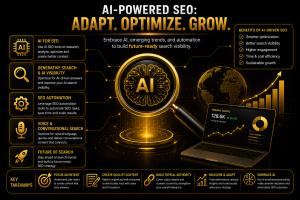
To prepare for the changing search environment, focus on the following areas:


1.Create Helpful, Original Content : Prioritize content that provides genuine value. AI can assist with research and production, but human expertise and original insights remain important.

2.Build Topical Authority : Create pillar pages and supporting content around related subjects. Use internal links to connect relevant articles.

3.Improve Content Structure : Use clear headings, concise explanations, lists, and logical page structures to make information easier to understand.

4.Use AI Strategically : Explore AI SEO tools and automation, but review outputs carefully. Accuracy and usefulness should always come before publishing speed.

5.Focus on User Intent : Whether users search through text, voice, or AI interfaces, the goal remains the same: understand what they need and provide the best possible answer.
 

SEO Strategy: A Complete Guide to Building Sustainable Search Visibility

SEO Strategy & Fundamentals: A Guide to Sustainable Search Visibility

A successful SEO strategy is more than just adding keywords to a webpage.
Today, businesses must optimize content for traditional search engines, question-based search experiences, and AI-driven discovery.This means integrating Search Engine Optimization (SEO), Answer Engine Optimization (AEO), and Generative Engine Optimization (GEO) to create content that is helpful, easy to find, and easy to understand.

This guide covers the key SEO fundamentals needed to build lasting search visibility and long-term website growth.

What Is SEO?

Search Engine Optimization (SEO) refers to the process of improving a website’s visibility in search engine results.
It involves optimizing content, site structure, technical performance, keywords, and user experience.The goal of an effective SEO plan is not just to rank for more keywords, but to attract the right audience by creating content that meets their needs and matches their search intent.

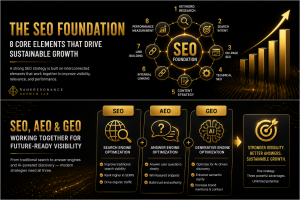
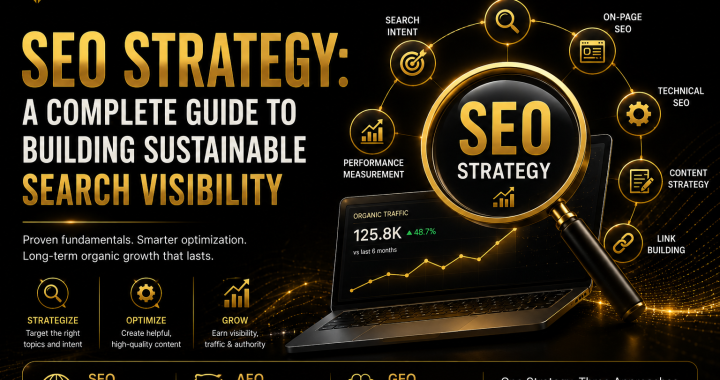
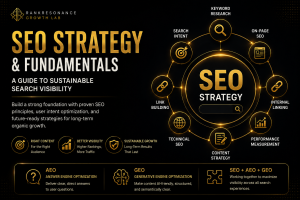
The main components of SEO include:
• Keyword research
• Search intent
• On-page SEO
• Technical SEO
• Content strategy
• Internal linking
• Link building
• Performance measurement

These elements work together to build a strong SEO foundation and support long-term organic growth.

1. Keyword Research and Search Intent

Keyword research helps you understand what your audience is searching for and how they look for information online.
However, modern SEO should not be limited to individual keywords.Search engines are now better at understanding topics, relationships, and user intent.

For example, an article about keyword research can naturally cover related topics like long-tail keywords, keyword difficulty, search volume, competitor analysis, and search intent.
Understanding search intent is just as important.Before creating content, ask: What does the user want to achieve?

Common types of search intent include:
• Informational
• Navigational
• Commercial
• Transactional

Matching your content with the right search intent improves its value and raises the chances of performing well in search results.

2. On-Page SEO

On-page SEO involves optimizing individual pages so both users and search engines can easily understand the content.
Key elements include:

• SEO titles
• Meta descriptions
• Headings
• URL structure
• Internal links
• Image optimization
• Relevant keywords

Your main keyword should appear naturally in key areas, while related keywords help provide context.
Avoid keyword stuffing.A solid on-page SEO approach focuses on relevance, readability, search intent, and covering the topic thoroughly rather than repeating the same keyword unnecessarily.

3. Technical SEO and Website Structure

Technical SEO ensures that search engines can easily crawl, understand, and index your website.
Important technical areas include:
• Crawlability and indexability
• XML sitemaps
• Page speed
• Mobile usability
• Canonical URLs
• HTTPS
• Structured data
• Website architecture

A clear and logical website structure helps both users and search engines find related content.
Important pages should not be hidden too deep in the website.A well-organized hierarchy increases crawlability and strengthens your overall SEO strategy.

4. Content and Topical Authority

High-quality content is a key part of successful SEO.
But simply publishing many unrelated articles doesn’t automatically build authority.A better approach is to create topic clusters.

A topic cluster usually includes:

1.A main pillar page covering a broad topic.
2.Supporting articles on specific subtopics.
3. Internal links connecting related content.

For example, “SEO Strategy & Fundamentals” can act as a pillar page linking to topics like keyword research, on-page SEO, technical SEO, off-page SEO, and SEO planning.
This structure strengthens topical relationships and supports long-term SEO growth.

5. Internal Linking

A good internal linking strategy connects related articles and helps search engines understand your site’s structure.
For instance:
SEO Strategy &  Fundamentals

→ Keyword Research
→ On-Page SEO
→ Technical SEO
→ Off-Page SEO
→ SEO Planning

Each supporting article should link back to the related pillar page and, where useful, to other related content.
Effective internal links help users discover more content, create clearer topic connections, and encourage further exploration of your website.

SEO and Answer Engine Optimization (AEO)

Answer Engine Optimization (AEO) focuses on structuring content to provide clear and direct answers to user questions.
People are increasingly searching using full questions such as:

• What is SEO?
• How does keyword research work?

How can I improve organic traffic?

To improve AEO, directly answer important questions before adding more details.

For example: What is an SEO strategy?

An SEO strategy is a structured plan for improving search visibility through content optimization, technical improvements, keyword targeting, internal linking, and authority building.

Useful AEO practices include clear headings, concise definitions, question-based sections, lists, and logically structured content.

SEO and Generative Engine Optimization (GEO)
Generative Engine Optimization (GEO) focuses on making content clear, useful, and understandable within AI-powered and generative search experiences.

The principles behind GEO overlap with strong SEO practices.
Content should provide:

• Clear explanations
• Accurate information
• Logical structure
• Strong topical coverage
• Recognizable concepts and entities
• Original insights and useful context

For GEO, it is important to clearly explain the relationships between topics.
For example, a website should show how SEO, AEO, GEO, keyword research, content strategy, and search visibility connect.
Semantic clarity helps both users and machine-based systems better understand your content.

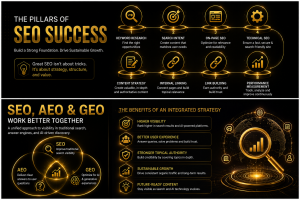
How SEO, AEO, and GEO Work Together
These approaches should not be treated as separate strategies.

Approach Primary Focus
SEO Improving traditional search visibility
AEO Providing direct answers to user questions
GEO Improving visibility and understanding in AI-driven search
A strong SEO strategy provides the foundation.
AEO improves how clearly your content answers questions, while GEO helps prepare your website for evolving AI-powered search experiences.
How to Build an Effective SEO Strategy

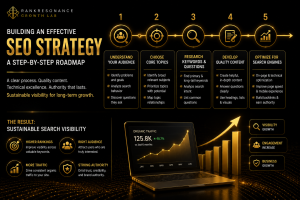
Follow these five steps:

1. Understand Your Audience Identify your audience’s problems, goals, questions, and search behavior. A successful SEO strategy begins with understanding user needs.

2. Choose Core Topics Identify broad subjects relevant to your website, such as SEO, content marketing, keyword research, technical SEO,  and digital growth.

3. Research Keywords and Questions Use keyword research to identify primary topics, long-tail keywords, and common questions your audience might search for.

4. Develop Quality Content Create content that provides value, answers user questions, and is well-structured.
Use headings, lists, and clear explanations to enhance readability and comprehension.

5. Optimize for Search Engines Ensure your content is optimized for search engines by using relevant keywords, improving website speed, and building backlinks.

By following these steps, you can build a solid SEO strategy that supports your overall online presence and helps improve organic traffic.

Learn More About SEO

If you’re starting your SEO journey or want a practical perspective on how to learn SEO from the ground up, watch this video:

SEO in 2025: How I’d Learn It if I Were Starting Over.